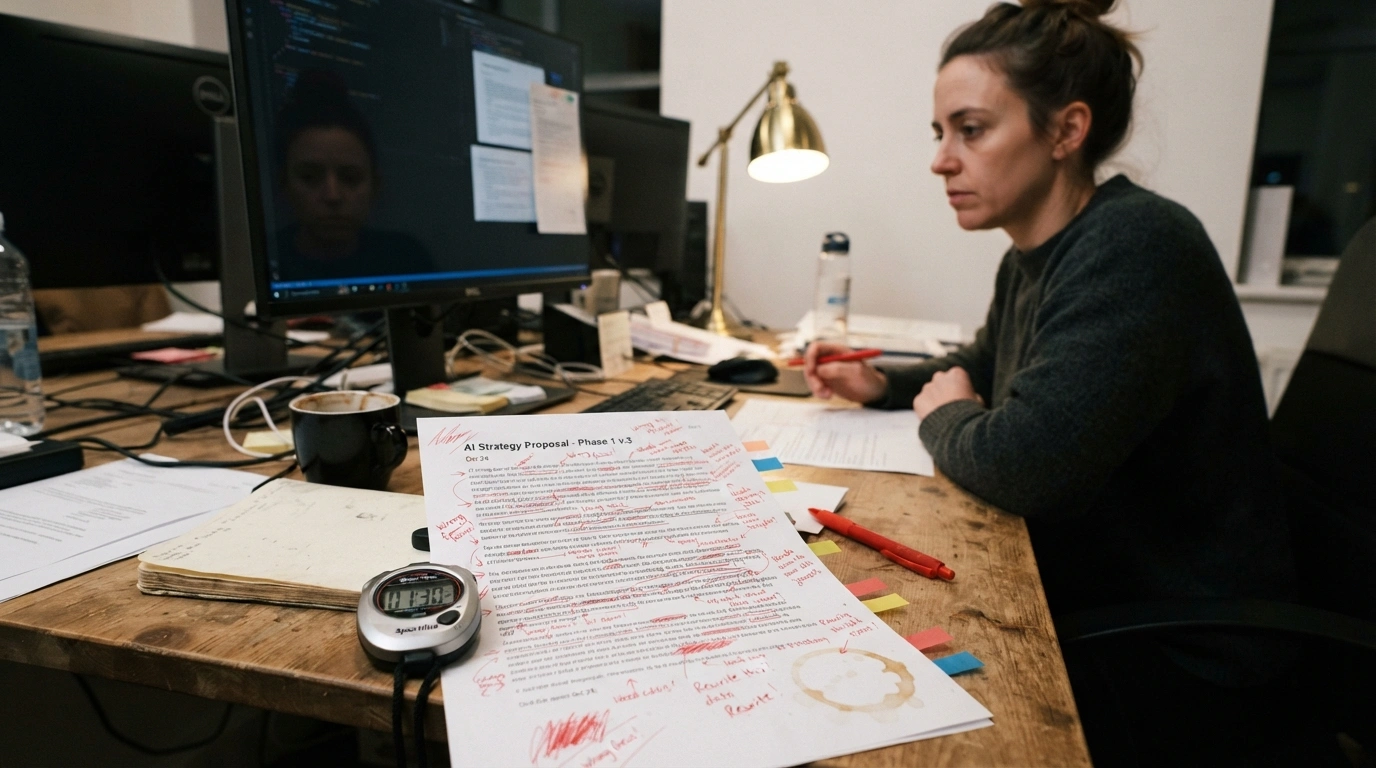
The most misleading number in AI productivity is the time it takes to generate a draft.
It is a real number. It is also the least interesting one. A draft that takes ninety seconds to generate and forty minutes to correct did not save you thirty-eight minutes. It cost you forty minutes and gave you a new document to manage.
I call the correction cost the cleanup tax: the editing, verification, correction, and coordination work that AI output creates after the generation step. If you do not measure it, you will mistake generation speed for time saved, and you will keep workflows that are quietly costing you more than they return.
This is how I measure the cleanup tax, what I have learned from tracking it across workflows, and the rules I now use to decide whether an AI workflow is worth repeating.
The demo is not the work. The cleanup is where the work either pays for itself or does not.
What the cleanup tax includes
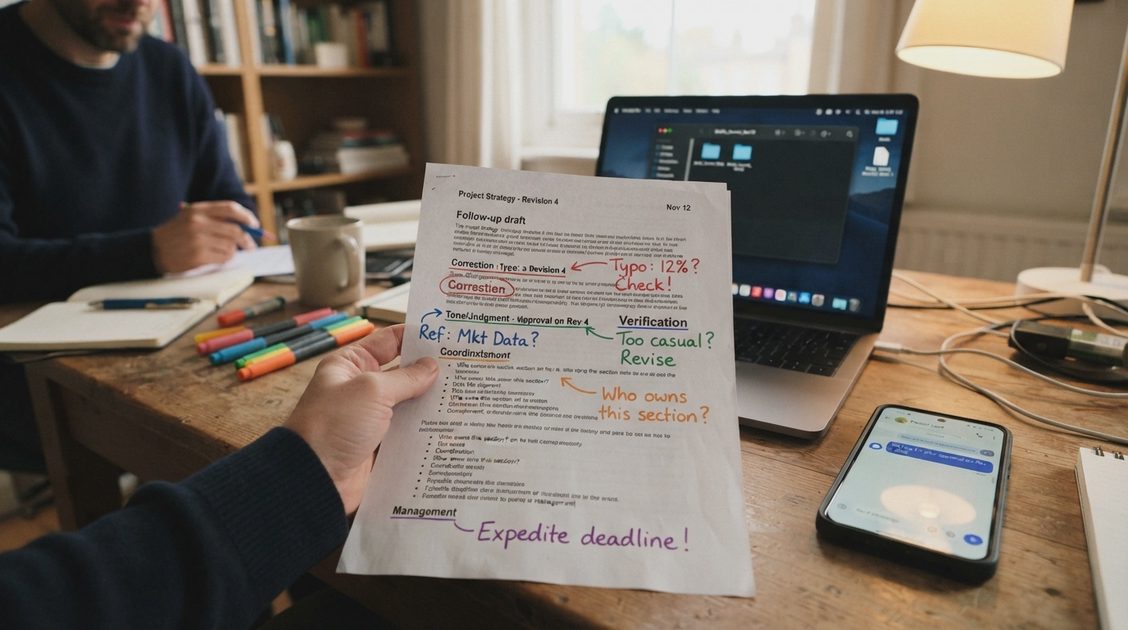
The cleanup tax is not just editing. It is every minute of work that exists because the AI produced a draft instead of a finished task. In my tracking, it has five components.
1. Correction time.
Fixing factual errors, invented commitments, wrong names, wrong dates, wrong scope. This is the largest component in client-facing work, because AI fills gaps with plausible assumptions.
2. Verification time.
Checking the draft against the source material: the project notes, the client request, the search results, the data. Verification is not optional, and it is not free.
3. Tone and judgment time.
Deciding whether the draft is appropriate for this client, this moment, this relationship. This is the component most people forget, and in a small business it is often the largest.
4. Coordination time.
Chasing the missing input, asking the reviewer, waiting for the approval, re-sending the draft because the context changed. AI does not remove coordination; it often adds a step.
5. Management time.
Keeping the draft, the version, the review note, and the final send in the right place. A draft is a new artifact, and artifacts need a home.
If you count only generation time, you count none of these. That is why the demo always looks better than the work.
Why the cleanup tax is easy to miss
The cleanup tax is easy to miss for three reasons.
It is distributed.
The generation happens in one block. The cleanup is scattered across the day: a correction here, a verification there, a tone check before sending. Distributed costs are hard to feel.
It is invisible in the tool.
WorkBuddy will tell you the draft is ready. It will not tell you how long you spent fixing it. The number has to be logged by a human.
It is socially inconvenient.
Nobody wants to admit that the AI workflow they championed is a net loss. The cleanup tax is the number that tells you the truth, and the truth is sometimes embarrassing.
The fix is not a better tool. It is a log.
How I measure the cleanup tax
I use a simple log in my “Time We Thought We Saved” spreadsheet. Every workflow gets a row, and every repetition gets four numbers.
Field | What goes in it |
|---|---|
Workflow | Plain name |
Repetition | First, second, third |
Generation minutes | Time from start to draft ready |
Cleanup minutes | Correction, verification, tone, coordination, management |
Judgment minutes | Time spent deciding whether it was safe to use |
Result | Sent as-is, sent with edits, rewritten, discarded |
Net | Generation + cleanup + judgment, compared with manual |
The manual comparison is the hard part. For most workflows, I estimate the manual time from past experience, and I am honest about the estimate. If the manual version used to take twenty-five minutes and the AI version takes two minutes to generate and eighteen minutes to clean up, the AI version is a five-minute win, not a twenty-three-minute win.
The judgment column is the one most people skip. It is also the one that decides whether a workflow is safe to hand off. If every draft requires the owner's judgment before it can be used, the workflow has a hidden cost that no generation-time metric will show.
What the data looks like
I have logged the cleanup tax across several workflows in my consultancy. The pattern is consistent, and it is not the one the demos suggest.
Mechanical, low-risk work — meta descriptions, title variants, internal link suggestions.
Generation: fast. Cleanup: low. Judgment: low. Net: clear win.
Structured drafting from a template — client updates, meeting records, project plans.
Generation: fast. Cleanup: moderate to high. Judgment: moderate. Net: a win only after the template and the review rule were fixed.
Freeform generation — long-form articles, strategy documents, sensitive client communication.
Generation: fast. Cleanup: very high. Judgment: high. Net: a loss or a wash. This work should not be automated without a brief and a review step.
Research summarization — search intent, competitor pages, reporting data.
Generation: fast. Cleanup: moderate. Judgment: moderate. Net: a win with verification.
The pattern: the cleanup tax rises with the amount of judgment the task requires. The tasks where AI looks most impressive are often the tasks where it saves the least time, because the judgment cannot be automated and the draft creates work around it.
What broke when I first started measuring
The first measurement was too generous.
I counted generation time and a rough editing estimate, and I ignored judgment time, coordination time, and management time. Two workflows looked like clear wins. When I added the missing components, one was a wash and the other was a net loss.
The second problem was the manual baseline. I estimated the manual time from memory, and my memory was flattering. The manual version of the client update had taken longer than I remembered, which made the AI version look better than it was. The fix was to log the manual time for the next three repetitions instead of estimating it.
The third problem was the sample size. One repetition is not a test. A workflow can look good on a calm Tuesday and fail on a busy Friday. The cleanup tax has to be measured across at least three repetitions, including one under pressure, before the number means anything.
By the third month, the measurement was honest: four numbers per repetition, a manual baseline from real logs, and at least three repetitions per workflow. That is the minimum for a number you can trust.
The rules I now use
The measurement changed how I decide whether a workflow is worth repeating. I use four rules.
Rule 1: If generation plus cleanup plus judgment is longer than the manual task, the workflow is a loss.
This is the honest measure. A fast draft is not a fast workflow.
Rule 2: If the cleanup tax rises with repetition, the workflow is not stable.
A workflow that gets more expensive to clean up over time is a workflow that is being used for the wrong tasks. The fix is to narrow the use case, not to try harder.
Rule 3: If the judgment time is larger than the cleanup time, the workflow is not ready to hand off.
Judgment time is the owner's time. If it is the largest component, the workflow is a personal habit, not a system.
Rule 4: If the workflow only wins on the routine case, that is still a win — but only for the routine case.
The routine client update can be automated. The sensitive client follow-up cannot. A workflow that is honest about its boundary is more useful than one that pretends to cover everything.
The Friday Test and the cleanup tax
The Friday Test and the cleanup tax are the same test from two directions.
The Friday Test asks whether the workflow still works when everyone is busy. The cleanup tax asks whether the workflow actually saved time. On a busy Friday, the cleanup tax rises, because the inputs are staler, the reviewers are busier, and the judgment is harder. A workflow that is a wash on Tuesday is often a loss on Friday.
That is why I measure at least one repetition under pressure. The Tuesday number is flattering. The Friday number is honest.
Did it pass the handoff test?
The measurement itself passed the handoff test. A team member can now log the four numbers and run the manual baseline without asking me. That is the point: the cleanup tax has to be measurable by the person who runs the workflow, not only by the owner.
The workflows that passed the handoff test were the ones with a low judgment component. The workflows that did not pass were the ones where the owner's judgment was the largest cost. The measurement made that visible, which is the first step toward fixing it.
Estimated time saved or lost
This article is about the measurement, not a single workflow, so the honest estimate is the one the measurement produced: the mechanical workflows saved time, the structured drafting workflows were a wash until the template and review rule were fixed, and the freeform workflows were a loss.
I would not generalize those numbers to another business. The useful result is the measurement method, not the estimate.
Who should use this measurement
Use it if you have adopted AI tools and you are not sure whether they are actually saving time. Use it if you are the person who reviews every draft and you suspect the review is the bottleneck. Use it if you want a number you can defend to yourself, your team, or your client.
Who should not use it
Do not use it if you are looking for a reason to reject AI. The measurement is honest in both directions: some workflows are clear wins. Do not use it if you are not willing to log the manual baseline. And do not use one repetition as a verdict. A single data point is an anecdote, not a measurement.
The smallest useful version
If you take one thing from this article, take the four numbers and the one rule.
Log generation, cleanup, judgment, and result for every repetition.
If generation plus cleanup plus judgment is longer than the manual task, the workflow is a loss.
That alone will tell you more about your AI workflows than any demo. The template and the three-repetition rule make it repeatable. The Friday repetition makes it honest.
Useful beats impressive. A workflow that survives the cleanup tax is useful. A fast draft is not the same thing.
FAQ
What is the cleanup tax in AI workflows?
The cleanup tax is the editing, verification, correction, coordination, and management work that AI output creates after the generation step. It includes fixing factual errors, checking the draft against the source, judging tone, chasing missing inputs, and keeping the draft in the right place. If you count only generation time, you miss all of it.
How do I measure the cleanup tax?
Log four numbers per repetition: generation minutes, cleanup minutes, judgment minutes, and the result. Compare the total with a manual baseline from real logs, not from memory. Measure at least three repetitions, including one under pressure, before you trust the number.
Why is the cleanup tax higher for judgment-heavy work?
Because AI is good at producing plausible output, and plausible output in judgment-heavy work is hard to verify and expensive to correct. The more judgment a task requires, the more time a human spends checking and correcting the draft. That is why freeform generation often costs more than it saves.
For AI tool features, rules and availability, refer to their official sites.



Leave your thoughts here, too.